Huwebes, Setyembre 11, 2014

SOURCES

http://iss.leeds.ac.uk/info/306/graphics/215/overview_of_computer_graphics/2
http://www.graphics.cornell.edu/online/tutorial/


Thank you for that sites that help making this blog.

#ComSci1

PIXEL

          In digital imaging, a pixel or picture element is a single point in a raster image. Pixels are placed on a regular 2-dimensional grid, and are often represented using dots or squares. Each pixel is a sample of an original image, where more samples typically provide a more accurate representation of the original. The intensity of each pixel is variable; in color systems, each pixel has typically three components such as red, green, and blue.
Charles Csuri

Charles Csuri

          Charles Csuri is a pioneer in computer animation and digital fine art and created the first computer art in 1964. Csuri was recognized by Smithsonian as the father of digital art and computer animation, and as a pioneer of computer animation by the Museum of Modern Art (MoMA) and Association for Computing Machinery-SIGGRAPH.
          Between 1971 and 1987, while a senior professor at the Ohio State University, Charles Csuri founded the Computer Graphics Research Group, the Ohio Super Computer Graphics Project, and the Advanced Computing Center for Art and Design, dedicated to the development of digital art and computer animation. Csuri was co-founder of Cranston/Csuri Productions (CCP), one of the world's first computer animation production companies. In 2000 Charles Csuri received both the 2000 Governor's Award for the Arts for the best individual artist, and The Ohio State University Sullivant Award, that institution's highest honor, in acknowledgment of his lifetime achievements in the fields of digital art and computer animation. His current exhibition "Beyond Boundaries" is a retrospective of seventy of his most groundbreaking works of computer art. The exhibition is scheduled to travel to museums in Europe and Asia. He is the founder of Ohio State's celebrated research center, The Advanced Computing Center for the Arts and Design (ACCAD).

IMAGE TYPES

* Two-dimensional


* Three-dimensional


* Computer animation


TWO-DIMENSIONAL

2D computer graphics are the computer-based generation of digital images—mostly from models, such as digital image, and by techniques specific to them.

2D computer graphics are mainly used in applications that were originally developed upon traditional printing and drawing technologies such as typography. In those applications, the two-dimensional image is not just a representation of a real-world object, but an independent artifact with added semantic value; two-dimensional models are therefore preferred, because they give more direct control of the image than 3D computer graphics, whose approach is more akin to photography than to typography.


THREE-DIMENSIONAL

3D graphics compared to 2D graphics are graphics that use a three-dimensional representation of geometric data. For the purpose of performance this is stored in the computer. this includes images that may be for later display or for real-time viewing.

Despite these differences, 3D computer graphics rely on similar algorithms as 2D computer graphics do in the frame and raster graphics (like in 2D) in the final rendered display. In computer graphics software, the distinction between 2D and 3D is occasionally blurred; 2D applications may use 3D techniques to achieve effects such as lighting, and primarily 3D may use 2D rendering techniques.

3D computer graphics are the same as 3D models. The model is contained within the graphical data file, apart from the rendering. However, there are differences that include the 3D model is the representation of any 3D object. Until visually displayed a model is not graphic. Due to printing, 3D models are not only confined to virtual space. 3D rendering is how a model can be displayed. Also can be used in non-graphicalcomputer simulations and calculations.


COMPUTER ANIMATION

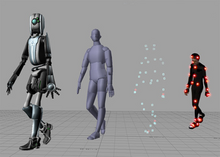
Computer animation is the art of creating moving images via the use of computers. It is a subfield of computer graphics and animation. Increasingly it is created by means of 3D computer graphics, though 2D computer graphics are still widely used for stylistic, low bandwidth, and faster real-time rendering needs. Sometimes the target of the animation is the computer itself, but sometimes the target is another medium, such as film. It is also referred to as CGI (Computer-generated imagery or computer-generated imaging), especially when used in films.


Example of Computer Animation


SOURCE : en.wikipedia.org

Miyerkules, Setyembre 10, 2014

HISTORY


The precursor sciences to the development of modern computer graphics were the advances in electrical engineering, electronics, and television that took place during the first half of the twentieth century. Screens could display art since the Lumiere brothers' use of mattes to create special effects for the earliest films dating from 1895, but such displays were limited and not interactive. The oscilloscope, the complex avionics control panel, and the naval control panels of the World War II period would prove to be the more direct precursors of the field, as they provided the first two-dimensional electronic displays that responded to user input. Early projects like the Whirlwind and SAGE Projects introduced the CRT as a viable display and interaction interface and introduced the light pen as an input device. A programmer for the Whirlwind SAGE system performed a personal experiment in 1954 in which a small program he wrote captured the movement of his finger and displayed its vector (his traced name) on a display scope. The same individual,Douglas T. Ross, working at MIT on transforming mathematic statements into computer generated machine tool vectors in 1959 took the opportunity to create a display scope image of a Disney cartoon character.One of the first interactive videogames to feature recognizable, interactive graphics was created for an oscilloscope by William Higinbothamto entertain visitors in 1958 at Brookhaven National Laboratory and simulated a tennis match. The phrase “Computer Graphics” itself was coined in 1960 by William Fetter, a graphic designer for Boeing. The field of computer graphics developed with the emergence of computer graphics hardware.


-en.wikipedia.org

OVERVIEW


The term computer graphics has been used in a broad sense to describe "almost everything on computers that is not text or sound". Typically, the term computer graphics refers to several different things:
the representation and manipulation of image data by a computer
the various technologies used to create and manipulate images
the sub-field of computer science which studies methods for digitally synthesizing and manipulating visual content, see study of computer graphics


Computer graphics is widespread today. Computer imagery is found on television, in newspapers, for example in weather reports, or for example in all kinds of medical investigation and surgical procedures. A well-constructed can present complex statistics in a form that is easier to understand and interpret. In the media "such graphs are used to illustrate papers, reports, thesis", and other presentation material.


Many powerful tools have been developed to visualize data. Computer generated imagery can be categorized into several different types: two dimensional (2D), three dimensional (3D), and animated graphics. As technology has improved, 3D computer graphics have become more common, but 2D computer graphics are still widely used. Computer graphics has emerged as a sub-field of computer science which studies methods for digitally synthesizing and manipulating visual content. Over the past decade, other specialized fields have been developed like information visualization, and scientific visualization more concerned with "the visualization of three dimensional phenomena (architectural, meteorological, medical, biological, etc.), where the emphasis is on realistic renderings of volumes, surfaces, illumination sources, and so forth, perhaps with a dynamic (time) component".


Source: en.wikipedia.org
Introduction

For me, computer graphics is representation of image data specifically with help from specialized graphic hardware and software. According to http://www.graphics.cornell.edu/ ,The term computer graphics includes almost everything on computers that is not text or sound. Today almost every computer can do some graphics, and people have even come to expect to control their computer through icons and pictures rather than just by typing.


I picked this topic because I want to learn many things about computer graphics. I want to learn how to make and use it. So, lets start now.